
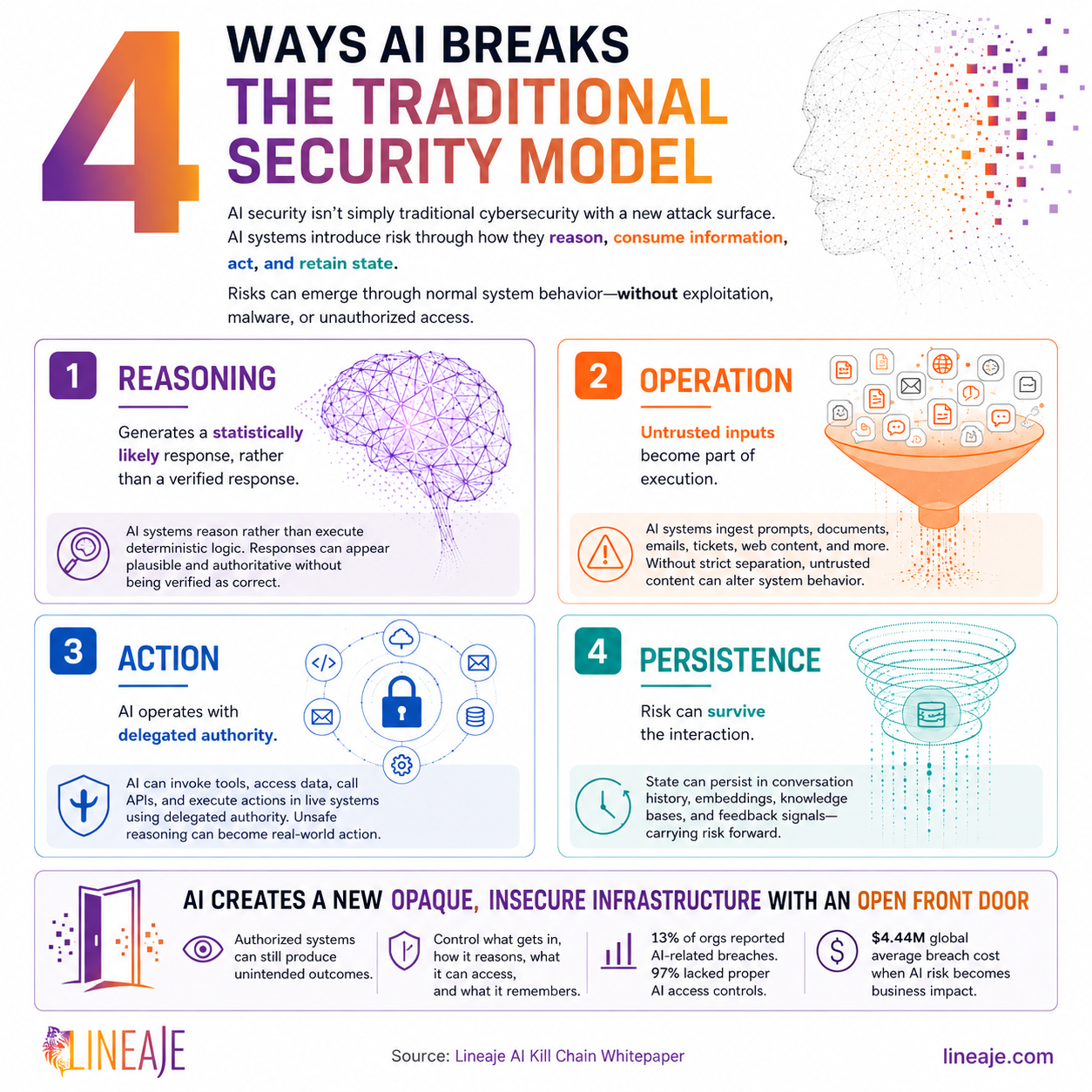
AI security isn’t simply traditional cybersecurity with a new attack surface. AI systems introduce risk through how they reason, consume information, act, and retain state. Unlike traditional application vulnerabilities, AI failures can occur without exploitation, malware, or unauthorized access—through normal system behavior operating without sufficient control over goals, authority, and memory.
The Lineaje AI Kill Chain identifies four structural characteristics that make AI fundamentally different from traditional software:
REASONING → Generates a statistically likely response, rather than a verified response.
AI systems reason rather than execute deterministic logic. They can infer intent, substitute goals, fill gaps in knowledge, and optimize helpfulness over correctness. The result can be a response that appears plausible and authoritative without first being verified as correct.
OPERATION → Untrusted inputs become part of execution.
AI systems ingest prompts, documents, emails, tickets, web content, and other external information. Without strict separation between data and instructions, untrusted content can alter system behavior.
ACTION → AI operates with delegated authority.
AI increasingly does more than generate an answer. It can invoke tools, access databases, call APIs, interact with live systems, and execute actions using delegated authority. The Kill Chain shows how unsafe reasoning can therefore become real-world action.
PERSISTENCE → Risk can survive the interaction.
Conversation history, vector embeddings, knowledge bases, and feedback signals can preserve state beyond a single session. Unsafe instructions, assumptions, or data can become embedded in AI memory and workflows, allowing their influence to persist across sessions and even remediation attempts.
These four characteristics don’t exist in isolation. The AI Kill Chain maps how they can compound across 10 stages, moving from AI reconnaissance and manipulation to tool exploitation, privilege escalation, persistence, AI-native command and control, and ultimately actions on objectives. Risk emerges when otherwise normal AI capabilities are chained together without sufficient governance.
The business impact is already measurable: 13% of organizations reported breaches involving their AI models or applications, and 97% of those organizations lacked proper AI access controls. The whitepaper also cites a $4.44 million global average breach cost, illustrating what can be at stake when AI risk becomes business impact.
Traditional security is designed largely around stopping unauthorized behavior. AI changes the equation because authorized systems can still produce unintended outcomes.
Securing AI requires control over not only what gets into the system, but how it reasons, what it can access, what authority it can exercise, and what it remembers.
AI doesn’t have to be compromised to create risk.
Source: Lineaje AI Kill Chain Whitepaper
